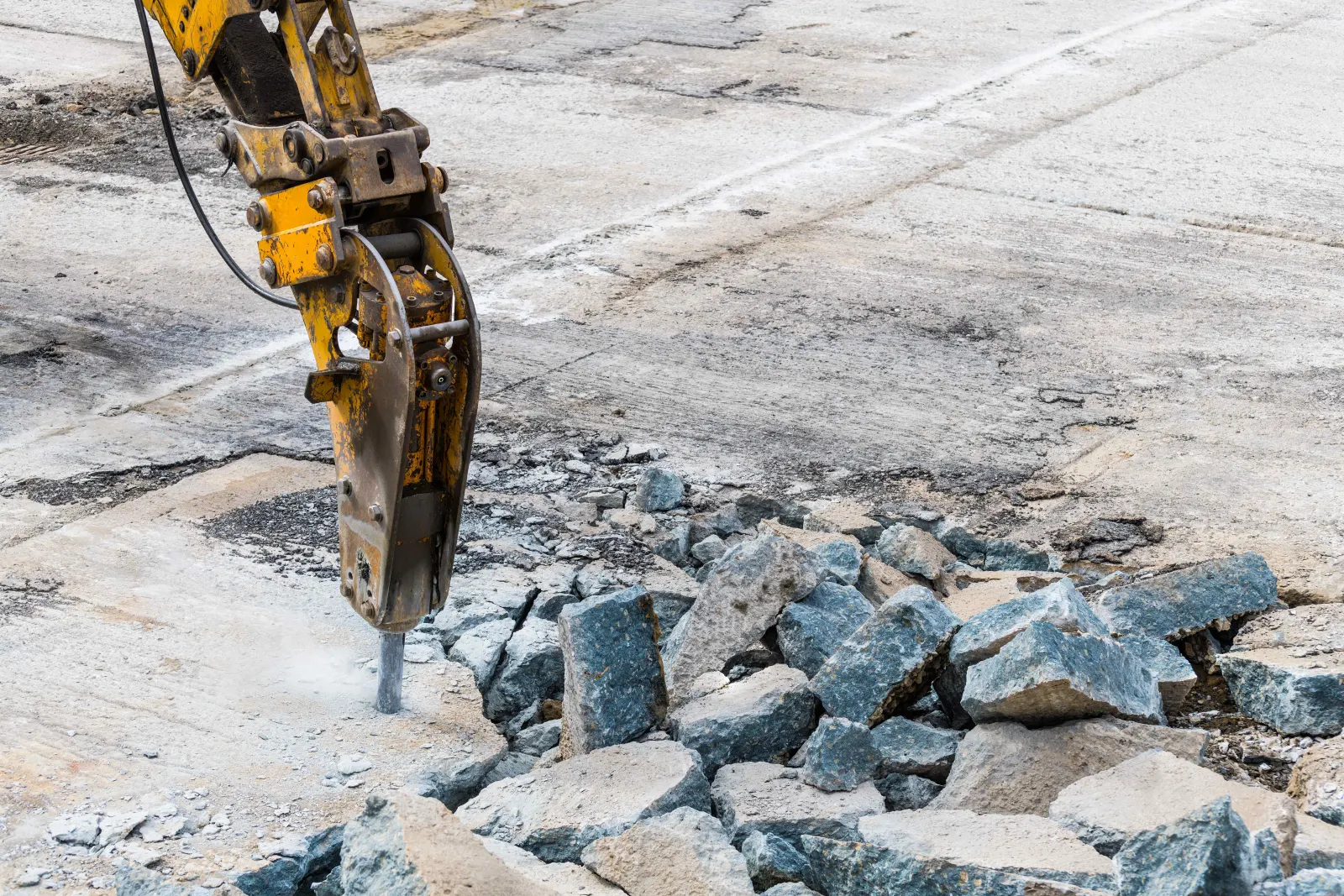
Concrete does not last forever here. Between forty-plus freeze-thaw cycles a season, road salt, and the loess and glacial-till soils under most of this area, a slab that was poured to a generic spec reaches the end of its life a lot sooner than the owner expects.
When it gets there, the honest answer is usually tear it out and pour it again properly, not patch the top of it. We do replacement work across Dubuque and the Tri-State area: driveways, sidewalks, patios, garage and basement floors, steps, aprons, and commercial slabs.
How to tell it is past saving
Any one of these on its own may be fine. Three or four together means the slab is finished:
- Cracks you can fit a finger into, or cracks that have kept opening year over year
- Sections sitting at different heights — one panel proud of its neighbour means the base moved
- Surface coming off in flakes or sheets — scaling, the signature of a mix that was not air-entrained for this climate
- Crumbling, rounded edges where the slab meets soil or asphalt
- Water standing on the slab after rain instead of running off it
- Rebar or mesh visible anywhere on the surface
- Rocking or movement you can feel when you drive or walk across it
The pattern that matters is what it says about the base. Surface wear is cosmetic. Movement is structural, and nothing applied to the top of a slab fixes what is underneath it.
Why we replace rather than resurface
An overlay, a patch, or a lift addresses the part of the slab you can see. Every failure mode listed above starts below it.
Replacement is the only point in a slab’s life when the things that actually determine how long it lasts can be corrected:
| What gets fixed | Only possible during replacement |
|---|---|
| Subgrade compaction | The base can be dug out, replaced, and compacted in lifts |
| Drainage and slope | Grade can be reset so water leaves the slab |
| Slab thickness | A 3” slab under a truck can become a 5” slab with rebar |
| Reinforcement | Mesh or rebar placed at the right depth, not sitting on the dirt |
| Air entrainment | The mix itself is specified correctly for Tri-State winters |
| Joint layout | Joints cut on time, at the right spacing, so cracks go where planned |
| Vapour barrier | On interior slabs, the one chance to get one under there at all |
That list is the whole argument. A resurfaced slab inherits every original mistake and hides them for a few seasons. A replaced slab does not have them.
What the job looks like
- On-site walk and written quote — we look at drainage, access, slab thickness at a broken edge, and what the base is made of. Quote back within 48 hours.
- Saw cut and demo — clean lines where new meets old, slab broken out and loaded
- Haul-off and disposal — clean concrete to a recycler where the site allows
- Subgrade work — soft or organic material dug out, replaced with rock, compacted in lifts, grade reset for drainage
- Forms and steel — mesh or rebar placed on chairs at the correct depth
- Pour and finish — air-entrained mix, finished to the specified texture
- Joints within 24 hours — sawcut at proper spacing, which is where most slabs are lost
- Cure — protection and a cure plan; sealer at 30 days
Dubuque replacement pricing, 2026
| Scope | Range |
|---|---|
| Tear-out and haul-off only | $2 - $4 per sq ft |
| Driveway replacement, all-in (approx 600 sq ft) | $6,000 - $10,000 |
| Sidewalk / walkway replacement | $11 - $17 per sq ft |
| Patio replacement | $10 - $16 per sq ft |
| Garage floor replacement, 2-car | $4,200 - $7,000 |
| Basement floor replacement (1,000 sq ft) | $8,500 - $13,000 |
| Partial panel replacement (per panel) | $600 - $1,600 |
| Steps, tear-out and repour | $1,400 - $3,500 |
All-in figures include removal, disposal, base rework, reinforcement, and the new pour. Slabs poured over rebar, over a previous slab, or on sites with poor access run toward the top of each range.
Partial replacement
Not every failed driveway needs all of it taken out. If the base under most of the slab is sound and two panels have gone, we saw clean lines, take out only the failed sections, and tie the new pour to the old with an isolation joint and dowels so the two can move independently.
Two things to know before choosing it. The new concrete will not match the colour of twenty-year-old concrete, and no amount of finishing will make it. And if the base under the whole slab is the problem, partial replacement just moves the failure to the next panel over. We will tell you which situation you are in, including when the answer costs us the bigger job.
Season and sequencing
Exterior replacement in the Dubuque area has a working window that generally closes in early to mid November. Concrete cures through a chemical reaction that slows sharply as temperatures drop, and a slab that freezes before it has gained strength is permanently weakened — which shows up later as scaling and a surface that comes apart.
Practically:
- Book September or early October and there is room for a weather delay
- Book in November and you are usually waiting for spring
- Demo and base prep can run later in the season than the pour can
- Interior slabs — basement and garage floors — go year-round
If the forecast will not hold, we will say so rather than pour something that fails. A slab poured into a bad week is not a saving.
Service area
Concrete replacement across Dubuque, Asbury, Peosta, Epworth, Farley, Bellevue, Dyersville, and Cascade in Iowa; East Dubuque and Galena in Illinois; Platteville in Wisconsin. Dubuque, Jackson, Jo Daviess, and Grant counties.