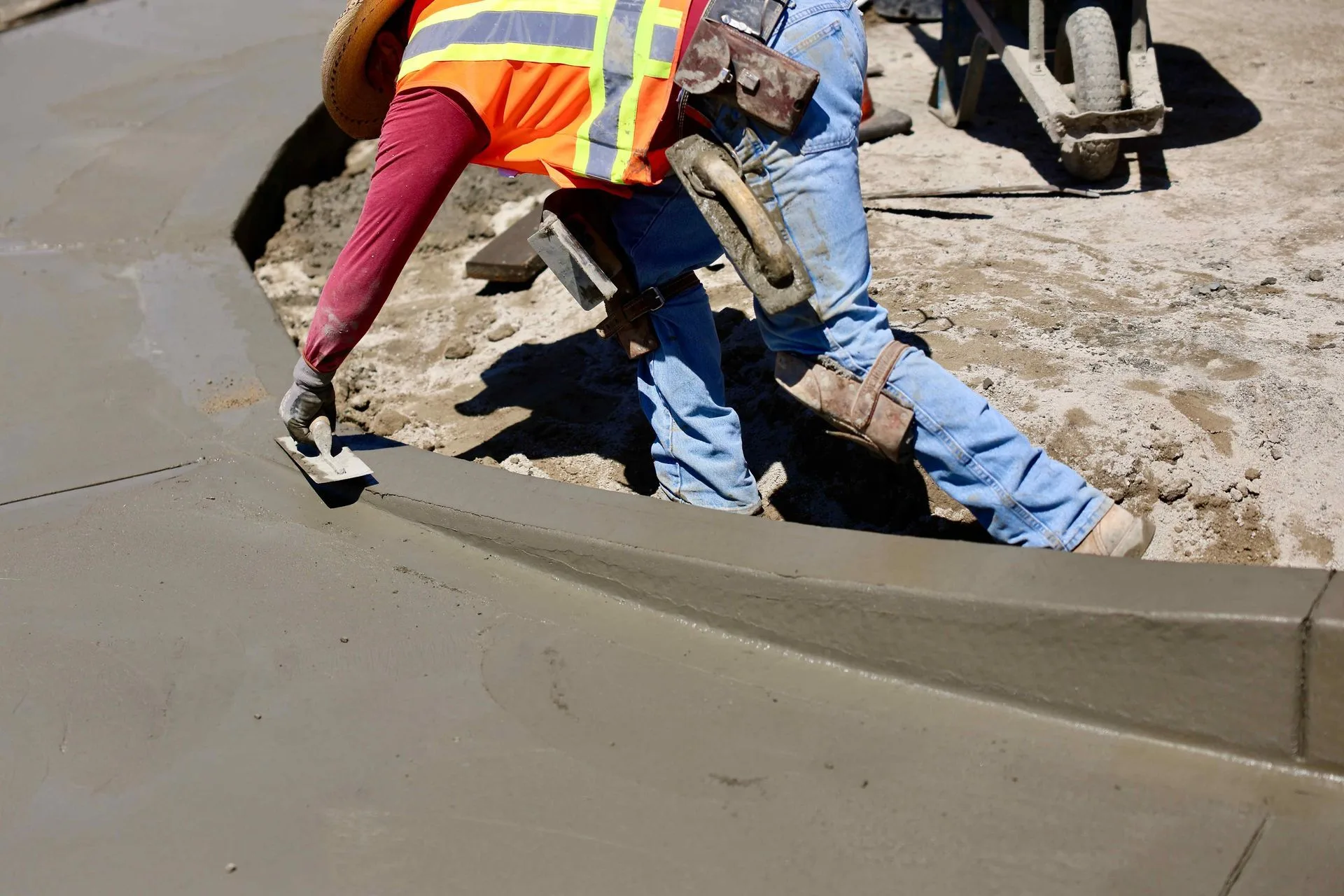
Curb is precision flatwork. There is nowhere to hide a bad line, an inconsistent profile, or a gutter pan that holds water instead of moving it. We pour curb and gutter for parking lots, subdivision streets, driveway entries, and landscape edging across Dubuque and the Tri-State area, in slip-form and hand-formed.
Curb profiles we pour
- 6” barrier curb — the standard residential and commercial face
- Curb-and-gutter, 18” or 24” pan — street and parking lot drainage
- Mountable curb — driveway crossings and vehicle entries
- Roll curb — the low-profile subdivision standard
- Slope-back curb — where an accessible or walkable perimeter is needed
- Continuous extruded landscape edging — 4” to 8” wide
- ADA curb cuts — compliant ramps with detectable warning surfaces
Slip-form vs hand-formed
Slip-form extrudes curb in a continuous run behind a machine. Long runs, consistent profile, lowest cost per foot. It needs room to work and a reasonably straight line, which makes it right for subdivision streets, parking lot perimeters, and commercial sites over roughly 200 feet.
Hand-formed is wood forms, set and stripped. More labor, more cost per foot, and the only option for tight radii, custom sections, short replacement runs, and sites where a machine cannot get in. Most Dubuque infill and older-neighborhood work is hand-formed for exactly that reason.
We quote whichever the site actually calls for rather than whichever we would rather run.
Dubuque pricing, 2026
| Scope | Range per linear foot |
|---|---|
| Landscape edging, extruded 4-6” | $7 - $14 |
| 6” residential barrier curb | $18 - $28 |
| Standard curb + 18” gutter pan | $22 - $34 |
| Heavy-duty commercial curb + 30” pan | $30 - $42 |
| Removal of existing curb | add $8 - $15 |
| ADA ramp with detectable warnings | $400 - $850 each |
Sites on a steep grade, with poor access, or requiring traffic control during the pour run toward the top of each range.
Tri-State spec matching
Working a three-state market means three sets of standards inside a 30-mile radius:
| Jurisdiction | What it drives |
|---|---|
| Iowa DOT | Standard sections for Dubuque, Asbury, Peosta, Dyersville, Cascade, Bellevue |
| Illinois DOT | East Dubuque and Galena work in Jo Daviess County; IL prevailing wage can apply on public-funded jobs |
| Wisconsin DOT | Platteville and Grant County; frost depth and reinforcement specs differ from Iowa |
| City of Dubuque | Right-of-way permits, inspection sequence, apron and approach details |
We carry the section drawings for all of them. If you are a property manager or a builder working across the river, you are not managing three contractors to get one consistent curb line.
Freeze-thaw and deicer spec
Curb takes more abuse than any other concrete on a site. It is thin, it is fully exposed, plow blades hit it, and the gutter pan is where salty meltwater collects and sits. Around Dubuque, with 40-plus freeze-thaw cycles a season and heavy winter salt on the hills, a curb poured to a generic spec fails at the pan long before the face wears out.
What we pour:
- Air-entrained mix, 5 to 7 percent, on every exterior curb
- 4,000 PSI minimum, 4,500 on heavy commercial and plow-route work
- #4 rebar continuous top and bottom on reinforced sections
- Control joints every 10 feet standard, 6 feet on subdivision runs
- Full cover over steel — thin cover at the pan is the usual reason a curb rusts out from inside
- Penetrating sealer on the top and face, reapplied roughly every 3 years
ADA curb cuts and detectable warnings
Every commercial curb cut we pour gets the full treatment. Iowa follows the 2010 ADA Standards with state amendments, and the details that get flagged in an audit are consistent:
- Running slope no steeper than 1:12, cross slope no steeper than 1:48
- 36-inch minimum clear ramp width
- Detectable warning surface across the full ramp width at the road edge
- Dome geometry 0.9-1.4” base, 0.45-0.9” top, 0.2” tall
- Visual contrast against the surrounding concrete, typically safety yellow or brick red
Any parking lot older than about five years usually has at least one curb cut that would not pass today. If you own or manage the property, the practical moment to fix it is when the lot is already being worked on, not as its own mobilization.
Where curb work usually comes from
- New subdivision streets and commercial site development
- Parking lot perimeters and islands
- Driveway entry and apron transitions
- Landscape bed edging, tree rings, and pool surrounds
- Replacing sections crushed by plows or delivery traffic
- ADA route upgrades for property managers
What we look at before quoting a replacement
Curb rarely fails as a material. It fails because of what is under it or what hit it:
- Spalling along the gutter pan — chloride attack plus a sealer that was never maintained
- Cracking at returns and transitions — control joints placed wrong or too far apart
- Settlement at the driveway approach — subgrade washout, usually a drainage problem upstream
- Impact breaks at islands and corners — plow and truck strikes, almost always at the same three spots in a lot
- Standing water in the pan — the original pour did not hold grade, which no amount of patching fixes
We will tell you which sections genuinely need replacing and which have years left. Quoting the whole run when forty feet is bad is how this trade gets its reputation.
Service area
Curb and gutter across Dubuque, Asbury, Peosta, Epworth, Farley, Bellevue, Dyersville, and Cascade in Iowa; East Dubuque and Galena in Illinois; Platteville in Wisconsin. Dubuque, Jackson, Jo Daviess, and Grant counties.